
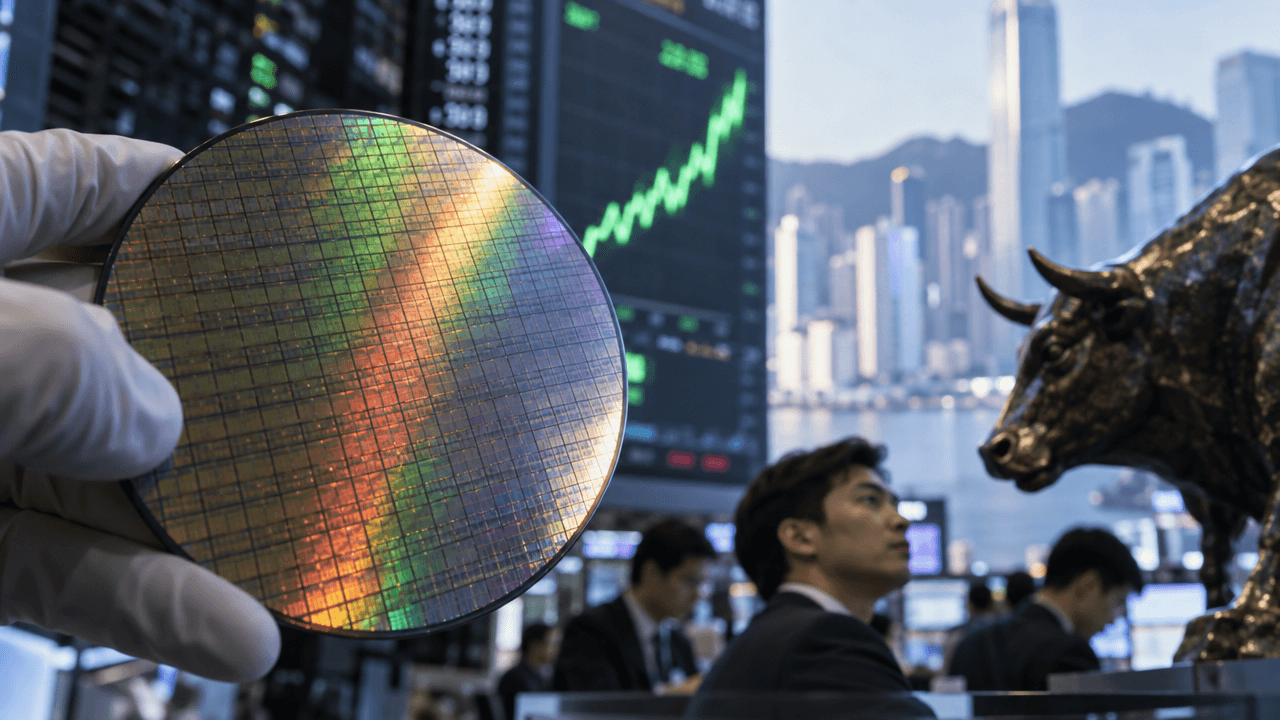
Asian equity futures and semiconductor shares surged as renewed optimism over artificial intelligence pushed investors back into technology stocks. The rally arrived at a pivotal moment, with major US technology companies preparing to report earnings and the Federal Reserve scheduled to announce its latest policy decision. Together, those events could determine whether the AI trade resumes its leadership role or faces another period of valuation pressure.
South Korea led the regional advance after SK Hynix delivered a powerful earnings signal. The memory-chip manufacturer reported third-quarter operating profit of 83.3 trillion won, representing a more than seven-fold increase from a year earlier and exceeding market expectations by more than 7%. [1] Its shares climbed sharply, while other semiconductor companies benefited from expectations that AI-related demand remains strong. [7]
The market response extended beyond one company. Reported trading showed the Nikkei gaining about 10% and the Kospi rising roughly 5.3%, reflecting broad enthusiasm for technology and cyclical assets. Equity futures for Japan, South Korea, and Australia also pointed higher after US chip stocks rallied. [12]
Why Ai Optimism Is Returning
The latest rally reflects a simple but important shift in investor expectations: spending on AI infrastructure may continue at a pace capable of supporting strong semiconductor earnings.
Training and operating advanced AI systems require enormous computing capacity. That demand supports manufacturers of high-bandwidth memory, processors, networking equipment, data-center systems, and related components. Memory chips are particularly important because they help AI accelerators process large data sets efficiently.
SK Hynix’s results provided evidence that this demand is translating into actual corporate profits rather than remaining only a market narrative. The company’s planned shareholder returns also strengthened confidence. It announced an additional return of approximately 60 trillion won, or about $45 billion, through dividends and share buybacks. Including an earlier commitment, total shareholder returns for 2026 were reported at 100 trillion won. [12]
For investors, this matters for two reasons. First, strong profits indicate that demand is reaching suppliers throughout the AI hardware chain. Second, large shareholder distributions can make a high-growth technology company more attractive by giving investors a direct financial return while they wait for future expansion.
Earnings And The Fed Create A Market Test
The rally is not occurring in isolation. Investors are waiting for earnings from major US technology companies including Alphabet, Microsoft, and Amazon. Their results and guidance will help answer several questions.
Are cloud providers still increasing capital expenditure at the same pace? Are AI services beginning to generate meaningful revenue? Can technology companies maintain profit margins while spending heavily on data centers and specialized chips?
Strong earnings and upbeat capital-spending plans could validate the current rally. However, signs that AI investment is slowing could quickly revive concerns about excessive valuations. The technology sector has already experienced sharp swings, demonstrating how quickly enthusiasm can turn into risk reduction.
The Federal Reserve decision adds another layer of uncertainty. Even companies with strong earnings can face pressure when interest rates rise because higher discount rates reduce the present value investors assign to future profits. A more supportive interest-rate outlook could help growth stocks, while a hawkish message could limit the advance in equities.
This combination explains why market participants are reacting strongly to both corporate earnings and central-bank communication. AI may be the primary theme, but interest rates determine how aggressively investors are willing to price that theme.
What The Rally Means For Traders
The immediate lesson is that semiconductor shares can act as a leading indicator for broader risk appetite. When chip stocks rise on credible earnings evidence, investors often become more comfortable buying technology, industrial, and growth companies. When chips fall, concerns can spread quickly across equity markets.
Still, traders should distinguish between a fundamental rally and a momentum-driven surge. SK Hynix’s earnings provide a fundamental catalyst, but large one-day gains can also attract short-term traders and increase volatility. Price movement alone does not prove that the entire sector has entered a stable long-term uptrend.
Useful questions include
Is the company increasing revenue as well as profits?
Are earnings supported by sustainable demand or temporary supply constraints?
Are management teams raising future guidance?
Are valuations already assuming exceptionally strong growth?
How are currency movements and interest rates affecting international companies?
For SimFi traders, the current environment offers a practical scenario for testing disciplined execution. A trader might create a watchlist containing SK Hynix, Samsung Electronics, Japanese chip-equipment companies, semiconductor exchange-traded funds, and major US technology stocks. The objective should not be to chase the strongest candle. Instead, traders can define entry levels, maximum risk, profit targets, and invalidation points before volatility increases.
Risk management is especially important around earnings and central-bank announcements. Wider price gaps can make stops less effective, while rapid reversals can punish oversized positions. Using smaller position sizes and waiting for confirmation may produce more consistent results than attempting to predict every headline.
The Bigger Market Picture
The Asian rally shows that AI remains one of the most influential themes in global markets. It also shows that investors increasingly want proof that massive AI spending is creating measurable financial returns.
Semiconductor companies sit at the center of that debate. Their results reveal whether demand for computing infrastructure is translating into orders, pricing power, and cash flow. SK Hynix has offered an encouraging signal, but upcoming technology earnings will determine whether the message is representative of the broader industry.
The most constructive outcome would be a combination of strong earnings, resilient capital spending, and a Federal Reserve communication that does not sharply tighten financial conditions. The most negative outcome would be weaker technology guidance paired with higher-for-longer interest-rate expectations.
For now, the evidence supports cautious optimism rather than unlimited confidence. AI enthusiasm has returned, and semiconductor earnings have reinforced the case for continued demand. But investors and SimFi traders should treat the rally as a market test: follow the earnings, respect the macroeconomic risks, and let risk controls matter as much as the story.