
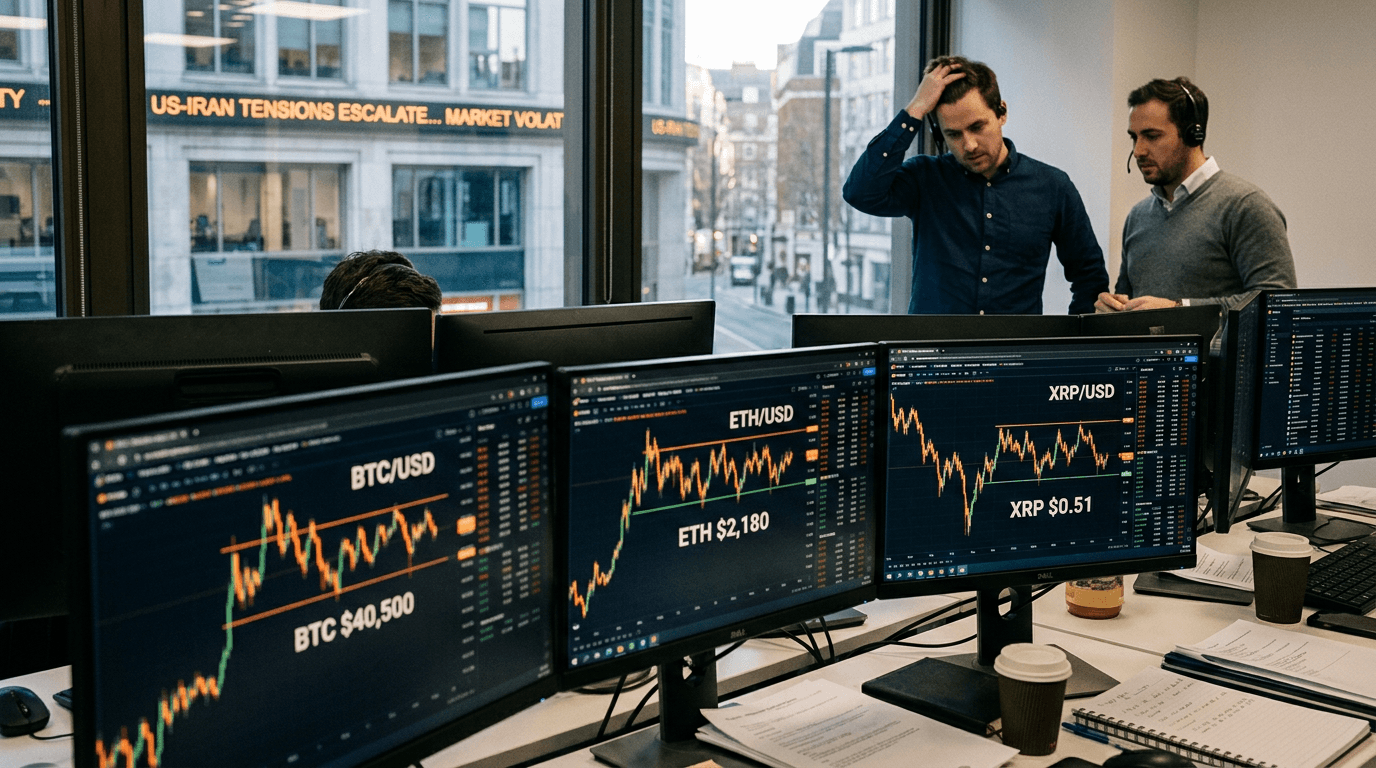
Crypto markets are walking a tightrope as traders balance war‑driven risk aversion with the appeal of digital assets as alternative stores of value. Bitcoin is holding above the psychologically important 71,000 area, Ethereum is orbiting the 2,000 mark, and XRP is trapped in a sideways consolidation after an approximate 2% pullback—price action that screams “caution” more than conviction.[3] Volatility is compressed, order books are thinner, and traders are clearly waiting for the next geopolitical headline before committing hard in either direction.[3]
Market Backdrop: War Risk And Risk Aversion
The extended US‑Iran war has pushed global markets deeper into risk‑off mode. In traditional assets, that usually means flows into cash, high‑quality bonds, and defensive sectors, alongside pressure on equities and higher‑beta currencies. Crypto, however, sits in a unique intersection: it trades both as a speculative risk asset and, increasingly, as a perceived hedge against geopolitical and monetary instability.[7]
That dual identity helps explain the current behavior. On one hand, heightened geopolitical stress is supporting the narrative for Bitcoin as a “store of value” outside the traditional financial system, underpinning demand on dips. On the other hand, the same risk aversion is discouraging leverage and aggressive trend‑following, keeping spot and derivatives flows choppy rather than directional.[3]
This dynamic is clearly visible in the price action. Bitcoin, Ethereum and XRP have all seen modest pullbacks from recent highs, followed by tight consolidation just above key support zones.[3] Intraday ranges have narrowed and volatility is compressing—a classical sign that markets are in “wait‑and‑see” mode rather than trending mode.[3] In such environments, news shocks from the war front or macro data can trigger outsized moves as positions are relatively light and liquidity pockets thin.
BITCOIN: ABOVE 71K, BUT STILL IN THE “PROVE IT” ZONE
Bitcoin trading above the 71,000 area has turned this level into a focal point for market psychology.[3] Bulls view it as a crucial line in the sand that must hold to keep the broader uptrend intact, while bears see any failure here as a potential catalyst for a deeper correction. For many short‑term traders, stops for long positions are clustered just below this zone, increasing the odds of sharp, stop‑driven moves if it breaks.[3]
From a technical perspective, this tight consolidation above support is a textbook compression phase. Price is moving in a narrow band, volume is modest, and each attempt to push meaningfully higher or lower stalls quickly. Markets rarely stay in this “coiled spring” state for long. When they do resolve, the move is often expansion‑driven: a break of the range that feeds on stop orders and fresh momentum flows.[1][3]
In a war‑driven risk‑off environment, traders need to think in scenarios. If 71,000 holds and is followed by strong volume on an upside breakout, Bitcoin could re‑engage its medium‑term bullish trend as investors lean into the “digital hedge” narrative. If that level fails on heavy selling, a flush toward lower support bands would not be surprising, especially if accompanied by a broader risk‑asset sell‑off.
ETHEREUM: RANGE‑BOUND AROUND 2,000 AS NARRATIVE EVOLVES
Ethereum is stable near the 2,000 mark, but “stable” here should not be confused with “strong.” Price has slipped from recent highs and is now oscillating around this key psychological and technical level, reflecting indecision among traders.[1][3] Unlike Bitcoin, which benefits more directly from the store‑of‑value narrative during geopolitical crises, Ethereum’s price is tied more to network activity, DeFi flows, and the broader appetite for smart‑contract risk.
The current war‑driven backdrop has two competing effects on ETH. Risk aversion weighs on speculative use cases, leverage, and smaller DeFi projects, potentially limiting upside for the Ethereum ecosystem. At the same time, the structural story—Ethereum as base layer for tokens, stablecoins, and on‑chain finance—remains intact, which helps attract dip buyers near major supports.[7]
Technically, Ethereum is compressing without strong momentum, similar to Bitcoin.[1] Price clusters around 2,000, with traders watching for either a clean rejection and move lower or a sustained push toward higher resistance zones. As with BTC, a volume‑backed breakout from this range, up or down, is likely to define the next swing.
Xrp: Sideways Consolidation After A Pullback
XRP is lagging the majors, moving in a sideways consolidation after an approximate 2% pullback from its recent highs. That underperformance reflects both asset‑specific uncertainties and the broader risk‑off tone. While Bitcoin and Ethereum enjoy relatively clear long‑term narratives—store of value and smart‑contract infrastructure—XRP’s story is more concentrated around cross‑border payments, regulatory developments, and adoption by financial institutions.[7]
Price action shows XRP holding in a relatively tight range rather than aggressively attracting dip buyers.[1][3] For short‑term traders, this can be both a frustration and an opportunity. The frustration is obvious: lack of follow‑through reduces trend‑trading potential. The opportunity lies in range‑trading—identifying well‑defined support and resistance zones and exploiting mean‑reversion while volatility is subdued.
However, XRP is also more vulnerable to event risk. Regulatory headlines, sudden shifts in legal outlook, or war‑related shocks to global payment flows can all trigger moves that break the range abruptly. In combination with already cautious sentiment, that means risk management needs to be especially disciplined.
What Traders Can Do: Playbooks For A Cautious Market
In compressed, cautious conditions like the current environment, three broad approaches tend to dominate trader behavior.[3]
First, support/resistance bounce trading. Many traders will lean long near well‑tested support (like BTC around 71,000 or ETH near 2,000) with tight stops just below, and look to sell or short near clearly defined resistance. This approach assumes the range will hold until proven otherwise, and it can be attractive when volatility is low and markets are headline‑driven.[3] Position sizing and disciplined exits are critical; when a range finally breaks, losses need to be small.
Second, breakout and breakdown trading. More conservative participants prefer to wait for the market to show its hand. They look for a decisive close beyond key levels, ideally confirmed by a pickup in volume and momentum indicators such as RSI or MACD, before entering.[3][5] In a war‑sensitive tape, this can help avoid getting chopped up in false moves, though it may mean sacrificing some early profit in exchange for clarity.
Third, risk‑centric strategy design. With geopolitical shocks in play, traders are increasingly designing their plans around risk first and returns second. That includes defining maximum portfolio drawdowns, diversifying across uncorrelated assets, and avoiding excessive leverage—especially in derivatives where liquidations can cascade quickly when volatility spikes.[3]
For traders using simulated finance (SimFi) platforms, this environment is an ideal laboratory. You can test how your strategies behave when price compresses, then suddenly expands on news; refine stop‑loss placement around obvious support levels; and practice scenario planning tied to macro and geopolitical headlines—all without putting real capital at risk. Building a rule‑based playbook now can pay dividends when conditions normalize or when the next major trend emerges.
In a market gripped by war‑driven risk aversion, Bitcoin, Ethereum, and XRP are sending the same message in different ways: capital is cautious, key levels matter more than ever, and the next decisive move is likely to be driven as much by macro headlines as by on‑chain or technical factors. For traders, the challenge is to respect the risk, stay patient during compression, and be ready with a clear, tested plan when volatility finally returns.