
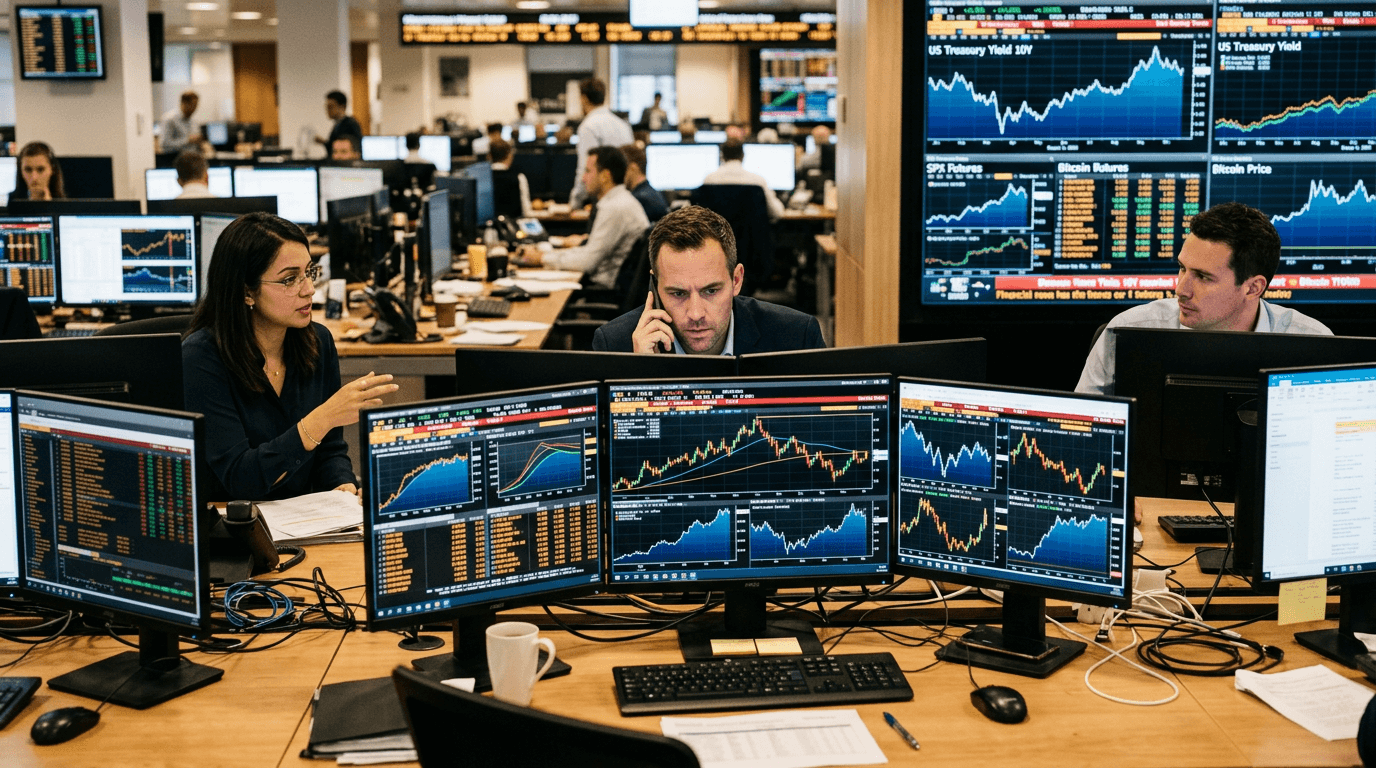
Global financial markets were jolted by the latest U.S.-Iran clash, which sent oil prices and bond yields sharply higher before stabilizing at elevated levels[3][7]. After the initial flight-to-safety and repricing of geopolitical risk, yields across major government bond markets are now broadly steady, but remain higher than before the confrontation, reinforcing a cautious tone across forex, equity futures, and crypto[3][4][7]. For traders, the key message is that the shock may have faded, but the signal from the bond market still demands respect.
Global Yields: From Spike To Steady, But Still Elevated
Geopolitical flare-ups involving Iran have a long history of rattling energy markets and, by extension, global bonds and currencies[7][9]. In this latest episode, U.S. crude futures jumped more than 5% and the benchmark 10-year Treasury yield was pushed to around 4.5%, one of the largest moves in months[3][7]. Higher oil prices feed into headline inflation and inflation expectations, and bond markets quickly price in the risk of more persistent price pressures.
What matters now is not just that yields spiked, but that they have stayed elevated even after the immediate clash has passed[3][4][7]. According to recent market coverage, global yields are no longer surging intraday, but are holding in a higher trading range than before the conflict[4]. That pattern tells traders that:
- The market is still pricing a meaningful risk premium for geopolitical and inflation uncertainty.
- Central bank expectations have shifted modestly toward “higher for longer” rather than swift easing.
- Volatility may be lower than at the peak of the clash, but the cost of capital across the system has risen.
In other words, steady does not mean benign. Steady and elevated yields can quietly reshape cross-asset pricing.
Why Steady, Higher Yields Matter For Every Asset Class
Government bond yields sit at the core of modern asset pricing. They represent the “risk-free” rate that underpins valuations in equities, credit, real estate, and even crypto through funding and carry costs. When yields jump and then hold at higher levels, three broad channels matter:
First, the discount rate effect. Equity valuations, especially for growth and long-duration assets, are highly sensitive to changes in yields and real rates. A 50–75 basis point move higher in long-term yields, sustained over time, can compress price-to-earnings multiples and make future cash flows look less attractive relative to safer bonds[3][7]. That is why equity futures typically weaken when yields spike, even if the economy itself has not yet changed.
Second, the inflation expectations effect. Oil shocks tied to conflicts around the Strait of Hormuz have historically fueled concerns about broader inflation and potential stagflation[7][9]. When investors see energy prices remain elevated, they anticipate higher input costs, possible pressure on corporate margins, and a more hawkish stance from central banks. That keeps traders focused on inflation prints, breakeven rates, and policy rhetoric.
Third, the risk-premium effect. A sustained geopolitical conflict raises required returns on risky assets: investors demand more compensation for uncertainty. Even when a temporary truce or framework to end hostilities is announced, markets often treat it as partial relief rather than full resolution, keeping volatility elevated and risk appetite constrained[2][4][8].
For traders on any platform, including SimFi environments, understanding these three channels is critical to reading cross-asset behavior in the wake of geopolitical shocks.
Forex: Yield Differentials Drive Currency Flows
Foreign exchange markets are highly sensitive to yield differentials between major economies. When U.S. or European yields rise and stay elevated, currencies linked to those markets often find support, especially against low-yielders.
In recent Iran-related episodes, the dollar index firmed while traditional safe havens behaved in mixed fashion: the Swiss franc strengthened marginally, while the yen – usually a classic safe-haven – unexpectedly weakened due to Japan’s heavy reliance on imported oil and shifting risk dynamics[1]. This highlights that:
- Higher U.S. yields, combined with elevated energy prices, can support the dollar against import-dependent economies.
- Safe-haven status is conditional; structural factors like trade balances and energy exposure matter as much as geopolitics.
- Emerging-market currencies tied to energy imports or with high external financing needs are particularly vulnerable when global yields are elevated.
For forex traders, the practical takeaway is to watch both absolute yield levels and the spread between regions. Steady but higher U.S. yields, for example, can keep carry trades attractive into the dollar and other high-yield currencies, but also increase tail risks if conflict escalates again.
Equity Futures And Crypto: Risk Assets Face A Higher Hurdle
Equity futures around the Iran conflict have tended to sell off on initial headlines, especially in sectors exposed to travel, energy costs, and global trade, before partially stabilizing as bond markets find a new equilibrium[1][2][4]. Relief rallies have emerged when ceasefires or diplomatic frameworks were announced, but analysts emphasize that these moves often reflect short-covering and unwinds of hedges rather than a durable shift in fundamentals[2][4].
Under a regime of steady, elevated yields, equity futures confront a higher hurdle:
- Defensive sectors and energy producers may outperform, benefiting from stable cash flows and higher commodity prices[1][2][7].
- Rate-sensitive growth names and speculative tech may see valuation pressure as discount rates remain elevated.
- Volatility indices and skew can stay rich, reflecting ongoing headline risk.
Crypto markets typically react as high-beta risk assets. Bitcoin, for instance, has shown an initial drop during heightened conflict and risk-off episodes, followed by partial recovery once the immediate panic eases[1]. However, in a world of higher yields, the “store of value” narrative competes with attractive real yields in traditional bonds. That can cap sustained upside in crypto unless monetary policy clearly shifts back toward easing.
For traders using simulated environments, these dynamics offer a valuable laboratory: testing strategies that respond to shifts in yields, risk sentiment, and cross-asset correlations without real capital at risk.
How Traders Can Navigate Cross-asset Caution
Geopolitical events like a U.S.-Iran clash are, by definition, unpredictable. What is predictable is how markets tend to process them: an initial spike in volatility, a rapid repricing of energy and yields, and then a period of cautious consolidation as traders reassess inflation, growth, and central-bank paths[3][7][8].
A few practical guidelines can help
- Anchor on the bond market. Track moves in key maturities (2-year, 10-year) and inflation breakevens; they often lead shifts in forex, equities, and crypto.
- Separate shock from signal. The first 24–48 hours are dominated by positioning and liquidity. The steady yield regime that follows tells you more about how investors see the medium term.
- Map scenarios. Consider how prolonged elevated energy prices could affect inflation, policy, and sector performance versus a rapid de-escalation with falling oil and lower yields.
- Use simulated trading to stress-test strategies. SimFi environments allow you to model cross-asset responses to spikes and regimes without the emotional and financial pressure of live markets.
Ultimately, steady but elevated global yields after a geopolitical clash are a reminder that the cost of capital and the market’s inflation narrative can change quickly and stay changed even after the headlines fade. For traders, the goal is not to predict every geopolitical twist, but to understand how the bond market translates those shocks into pricing across forex, equities, and crypto – and to build robust strategies around that reality.