
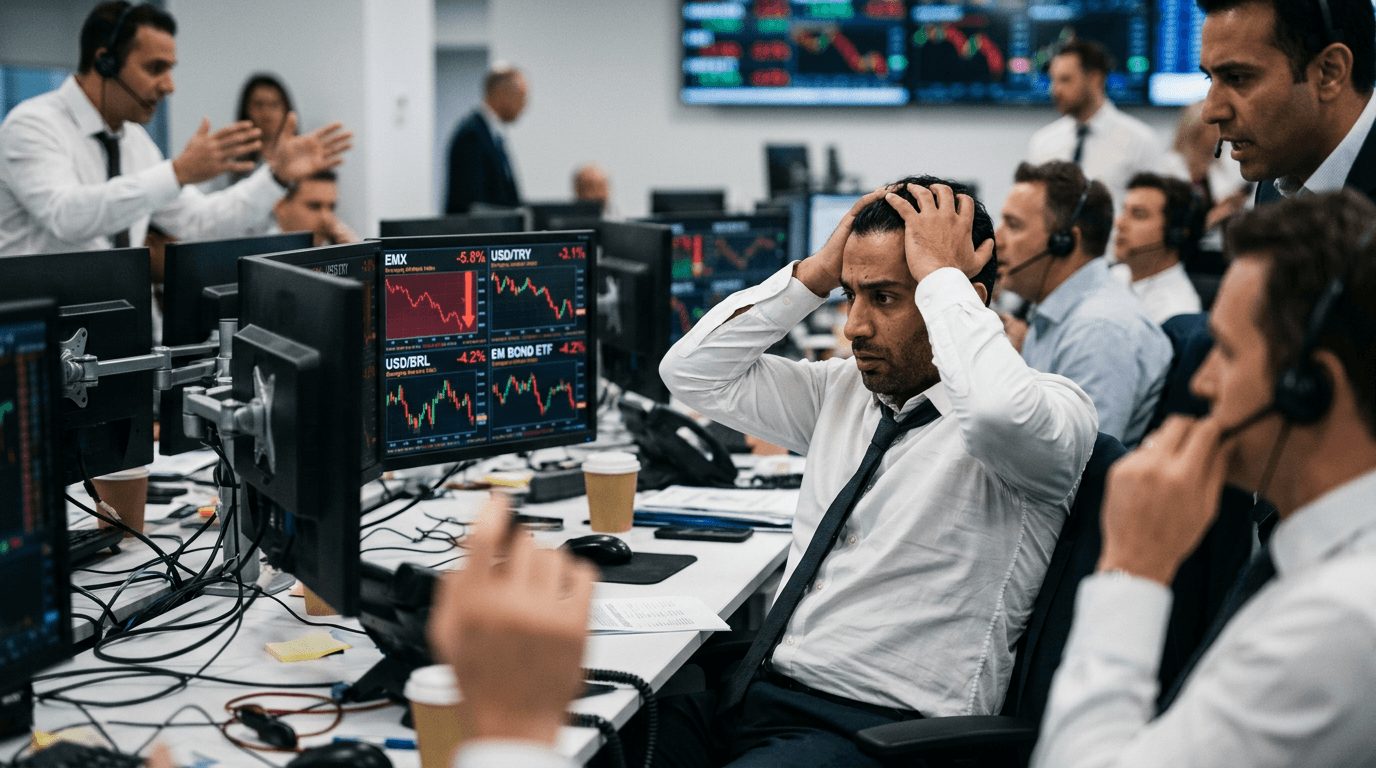
Emerging markets have been thrust back into the global spotlight as the Iran conflict triggers a sharp risk‑asset selloff, hitting equity funds, currencies and bond markets across the developing world.[1][3] After a strong run earlier in the year, many investors are now rapidly de‑risking, exposing just how sensitive emerging‑market assets remain to geopolitical shocks.[1][3] For traders and portfolio builders, this episode offers both a cautionary tale and a valuable case study in managing risk when macro uncertainty spikes.
MARKET SHOCK: IRAN CONFLICT AND RISK‑OFF SENTIMENT
The escalation of conflict involving Iran has catalyzed a classic “risk‑off” move: investors are cutting exposure to riskier assets and rotating into perceived safe havens such as developed‑market government bonds and the US dollar.[1][3] Historically, emerging‑market equities and local‑currency assets tend to be among the first to suffer in such episodes, given their higher volatility and reliance on stable global growth and capital flows.
In recent weeks, emerging‑market stocks have given back their gains for the year as energy prices and geopolitical risk premia jumped.[4] The benchmark MSCI Emerging Markets Index has posted its sharpest monthly retreat since the pandemic shock in 2020, with one week marking its biggest drop in six years.[3][4] This sudden reversal illustrates how quickly sentiment can turn when markets reassess growth, inflation and geopolitical risk simultaneously.
For traders, the key takeaway is that geopolitical shocks rarely stay “local” for long. Even if the conflict is geographically contained, its impact on energy prices, global supply chains and risk appetite can ripple across portfolios that may not have any direct exposure to Iran at all.[3][4]
Em Equity Funds: From Leaders To Laggards
Emerging‑market equity funds have moved from being favored trades to ranking among the weakest performers across asset classes during the Iran‑driven selloff.[1][5] Data from fund sectors shows average losses of around 9–10% since the start of the conflict for global emerging‑market equity funds, with none managing a positive return over the period.[5] Strategies focused on markets such as Chile, Argentina, the UAE and Saudi Arabia are among the steepest decliners, reflecting their sensitivity to commodity prices and capital‑flow volatility.[1]
This broad drawdown masks important dispersion beneath the surface. A handful of funds have outperformed peers by losing less, often due to more defensive sector tilts, stronger balance‑sheet companies or lower exposure to the most volatile countries.[5] Some China‑focused strategies have also maintained top‑quartile performance both in the year prior to the conflict and during the war period, showing that emerging markets are not a monolith.[5]
For investors using simulated finance platforms, this is a powerful lesson in fund selection and factor exposure. Two practical ideas stand out:
- Look beyond headline returns and focus on downside protection: funds that consistently lose less in stress periods can compound value over full cycles, even if they lag slightly in strong bull markets.[5]
- Understand each fund’s country, sector and factor tilts: being “in emerging markets” can mean very different things depending on whether the portfolio leans into commodities, tech, financials or defensive consumer names.
Pressure On Currencies, Bonds And Carry Trades
The de‑risking wave is not confined to equities. Emerging‑market currencies and sovereign bonds have also come under pressure as investors unwind carry trades and reduce exposure to risk‑sensitive economies.[3][6] Carry trades—borrowing in low‑yielding currencies to invest in higher‑yielding emerging‑market FX or bonds—depend on stable risk sentiment and low volatility. When conflict‑driven uncertainty rises, these trades can be quickly reversed, amplifying moves in foreign‑exchange and rates markets.
Bond yields in several emerging economies have jumped as global investors demand a higher risk premium or simply exit positions to reduce overall portfolio risk.[3][9] Emerging‑markets hedge funds have reported sharp declines, with EM indices down around mid‑single digits month‑to‑date, reflecting losses across equities, FX and credit.[9] Local currencies have weakened against the dollar, tightening financial conditions and raising concerns about imported inflation in commodity‑dependent economies.[3][4]
For traders active in FX and rates, three risk‑management themes emerge:
- Correlation risk: in stressed markets, previously diversified positions in EM equities, FX and bonds can all move in the same direction, reducing the effectiveness of diversification.
- Liquidity risk: bid‑ask spreads tend to widen and depth thins out, especially in frontier markets and thinner‑traded currency pairs, increasing transaction costs and slippage.
- Leverage risk: leveraged carry trades are particularly vulnerable; small moves in FX or yields can translate into outsized P&L swings or margin calls.
Navigating Em Volatility: A Framework For Investors
Despite the sharp selloff, several large asset managers remain constructive on the longer‑term case for emerging markets, emphasizing improved fundamentals and better policy frameworks relative to past cycles.[3][6] Many EM economies now run more orthodox monetary policy, have higher FX reserves, and rely less on external debt than in earlier decades, which can help them weather temporary shocks.[6]
One key recommendation from institutional managers is to avoid treating emerging markets as a single macro trade and instead allocate selectively across regions, countries and asset classes.[6] That means distinguishing energy exporters from importers, reform‑oriented economies from those with weak institutions, and equity markets driven by global tech demand from those reliant on commodity cycles.
A practical framework for investors and simulated traders might include:
- Country differentiation: build scenarios for how the Iran conflict affects oil prices, trade flows and regional politics—and then map which EMs are likely winners or losers under each scenario.
- Tactical tilting between equity and debt: in periods of elevated equity volatility, some investors may prefer local‑currency bonds or hard‑currency sovereign debt, while others might see dislocations in stocks as an opportunity.[3][6]
- Focus on resilient companies: tilt toward firms with strong pricing power, robust balance sheets and strategic importance to their economies; these business models are more likely to navigate periods of higher energy costs and slower global growth.[6]
SIMULATED FINANCE: PRACTICING FOR REAL‑WORLD SHOCKS
For traders using simulated finance (SimFi) platforms, episodes like the Iran conflict offer an ideal environment to stress‑test strategies without putting real capital at risk. By replaying the sequence of events—initial headlines, market gaps, follow‑through selling and partial rebounds—participants can see how their systems handle sudden volatility spikes, correlation breakdowns and liquidity constraints.
In a simulated setting, traders can:
- Test portfolio reactions to different geopolitical scenarios: further escalation, a rapid cease‑fire, or a protracted stalemate, each with distinct implications for oil, EM FX and equities.
- Experiment with hedging techniques: using index futures, FX options or duration shifts in bond portfolios to reduce drawdowns when risk sentiment deteriorates.
- Analyze behavior under stress: do they cut risk too late, over‑react to noise, or fail to adjust position sizing in line with volatility? Identifying these patterns in simulation helps build discipline for live markets.
Ultimately, the Iran‑driven selloff in emerging‑market assets underscores a timeless lesson: return potential in EM comes with meaningful geopolitical and macro risk, and success depends less on predicting every headline than on building robust, adaptable strategies. For traders and investors alike, combining selective fundamental views with rigorous risk management—and practicing those approaches in realistic simulations—offers the best path to turning turbulent markets into long‑term opportunity.