
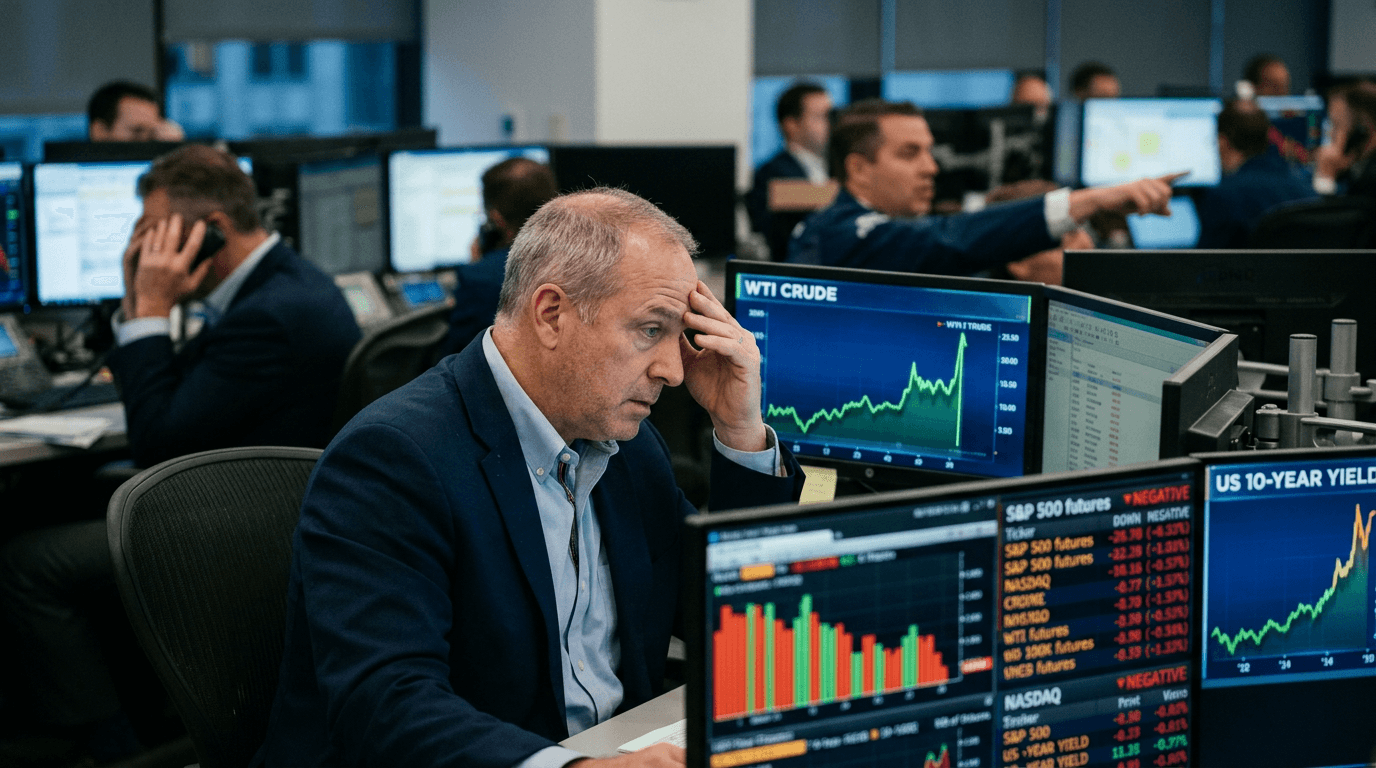
Global markets were reminded this week that geopolitics can still move prices faster than any economic report. Crude oil spiked as much as 9% during the U.S. session, briefly pushing WTI above $81 and Brent near $86 before easing as signs of de-escalation emerged. The shock has hit risk assets, lifted inflation worries, and forced traders to rethink how many – and how soon – Federal Reserve rate cuts are really on the table.
Global Oil Shock: Why Tensions Matter So Much
The trigger for the move was a fresh flare-up in U.S.–Iran hostilities, including renewed American strikes and the effective tightening of sanctions on Iranian oil exports.[2][8] With shipping through the Strait of Hormuz repeatedly disrupted and waivers on Iranian crude revoked, traders rushed to reprice the risk of a more prolonged supply squeeze.[4][7][8]
The Strait of Hormuz handles a large share of global seaborne oil flows, and recent reporting indicates traffic has at times slowed to a near standstill as hostilities escalated.[4][7] When that corridor is threatened, the market adds a “risk premium” to oil prices – not because barrels disappear overnight, but because the odds of future disruption suddenly rise.[9]
As a result, crude has swung sharply. Brent and WTI have repeatedly posted single-day gains of 3–6% on Iran-related headlines in recent weeks, reversing what had been a gradual return to pre-war price levels.[1][8][9] The latest 9% intraday spike fits this pattern: fast, headline-driven moves layered on top of already-elevated volatility.
Why Higher Oil Prices Rattle Risk Assets
For equities, the first-order impact is simple: higher energy costs compress margins and threaten consumer spending. Stock indices have sold off as traders price in the potential for weaker growth and stickier inflation, with large-cap benchmarks dropping more than 1% on some of the most intense Iran news days.[4][11]
Sector performance has been uneven. Energy stocks often benefit from higher crude, but that upside is increasingly offset by fears of demand destruction if oil stays expensive for long. Cyclical sectors such as consumer discretionary and industrials tend to underperform in these episodes, as investors lean away from companies most exposed to fuel prices and global trade disruptions.
Safe-haven demand has also reappeared. When geopolitical risk spikes, capital often rotates into assets perceived as safer, including high-quality bonds and, in some cases, defensive equity sectors. At the same time, volatility indices rise, and options markets price in a higher probability of large moves across indices and single stocks.
Inflation, The Fed, And Shifting Rate-cut Bets
The most important macro impact of an oil shock is on inflation expectations. Energy is a volatile component of consumer price indices, but sustained moves in crude still feed through to gasoline, transportation, and eventually broader price levels.[4][10] That is especially problematic when underlying inflation is already above target.
Recent tensions have come at a time when the Federal Reserve is trying to decide how quickly it can pivot from fighting inflation to supporting growth. A renewed rise in oil prices complicates that calculation. Higher pump prices and shipping costs risk slowing the disinflation process, making central bankers more cautious about cutting rates too aggressively.[4]
Futures markets and interest rate swaps quickly reflect these shifts. When oil surges on geopolitical headlines, traders often reduce the number of rate cuts priced in for the coming year or push them further into the future, effectively tightening financial conditions relative to prior expectations. This dynamic explains why the latest oil shock has “rattled” rate-cut bets: the move increases the probability that the Fed adopts a wait-and-see stance rather than easing preemptively.
FX AND BOND MARKETS: SAFE HAVENS VS. INFLATION FEARS
In foreign exchange, higher oil prices and Gulf tensions have supported the U.S. dollar against many peers, as safe-haven flows and higher expected U.S. yields intersect.[3] The dollar has held firm or strengthened against the yen in particular, with the Japanese currency under pressure as oil-linked inflation risks complicate Japan’s own delicate policy mix.[3]
At the same time, bond markets must balance competing forces. Geopolitical risk and equity weakness tend to push yields lower as investors seek safety, but higher inflation expectations and reduced confidence in rate cuts push yields higher. The net result is often a choppy, range-bound environment where breakeven inflation rates rise faster than nominal yields, signaling that traders see more price pressure but limited clarity on growth.
For multi-asset investors, this cross-market interaction is crucial. A single shock – in this case, U.S.–Iran hostilities and oil – influences stocks, bonds, FX, and commodities simultaneously, and portfolios that ignore these linkages can end up unintentionally concentrated in one macro scenario.
How Traders Can Navigate Oil-driven Volatility
For active traders, an oil shock is both a risk and an opportunity. Moves driven by geopolitical headlines are often sharp but can fade quickly if de-escalation signs emerge, as seen when crude gave back part of its 9% spike once the tone of news flow improved. That makes position sizing and risk management more important than directional conviction.
A few practical takeaways
- Treat geopolitics as a volatility regime, not a one-off event. As long as U.S.–Iran tensions remain unresolved and Strait of Hormuz traffic is vulnerable, the market will maintain some risk premium in oil and related assets.[4][7][8][9]
- Watch inflation expectations and rate pricing, not just spot crude. Equity and FX reactions often hinge more on what the oil move implies for central banks than on the price of oil itself.
- Use scenario analysis. Consider how your portfolio behaves if oil stays elevated, normalizes quickly, or spikes further. Identify trades that are robust across scenarios, and where your exposure is too concentrated in one outcome.
- Practice in a risk-free environment. Simulated finance platforms allow traders to test how equity, FX, and rate trades perform through oil-driven macro shocks without putting real capital at risk. That can be invaluable for understanding cross-asset dynamics before committing to live positions.
For longer-term investors, the key is to separate short-lived price spikes from structural shifts. A temporary disruption that eases with de-escalation will have a different macro footprint than a prolonged conflict that keeps the Strait of Hormuz constrained for months. Monitoring shipping data, policy responses, and energy company guidance can help distinguish between the two.
Ultimately, the latest oil shock is a reminder that macro and geopolitics are never fully “priced in.” When hostilities flare in a region as critical as the Gulf, markets must rapidly re-evaluate growth, inflation, and policy paths – and that re-pricing will show up across risk assets and rate-cut expectations long before the fundamental data catch up.