
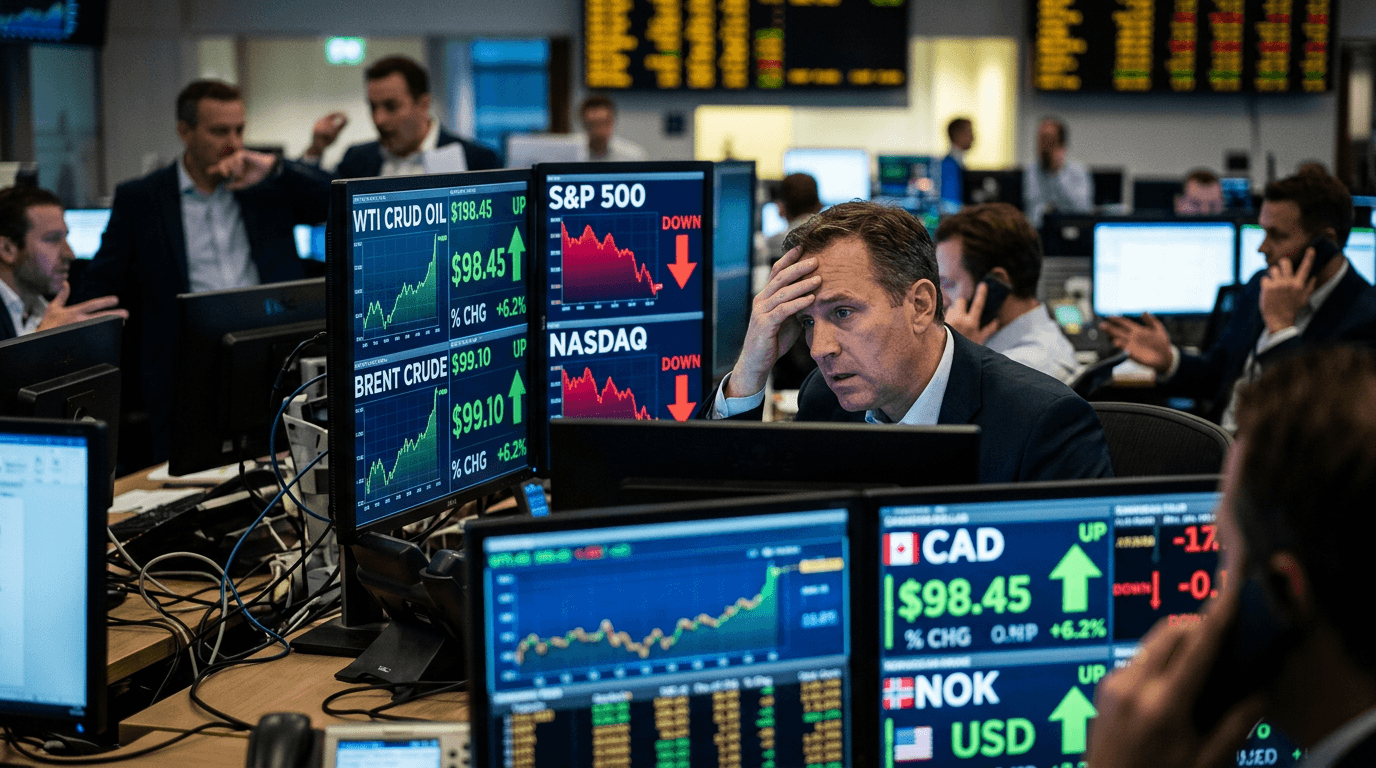
Oil markets just delivered a stark reminder that geopolitics still rules the macro cycle. A sudden escalation in the Iran conflict sent crude prices surging intraday, with the US benchmark jumping close to 9% and briefly trading near or above the psychologically important $100 per barrel mark.[1][2] Energy stocks and oil-linked currencies rallied, while global equity index futures slid and volatility measures spiked. For traders, this is not just another headline—it’s a full-spectrum macro shock touching commodities, equities, bonds, and FX all at once.
Why An Iran-driven Oil Spike Matters
Oil shocks are not created equal. A move from $70 to $75 is one thing; a rapid jump toward $100 in the context of a Middle East conflict is quite another.[1] When the trigger is a geopolitical flashpoint like Iran, markets do not just price higher spot oil—they price risk premia, the extra compensation investors demand for uncertainty around supply, shipping, and escalation.[3]
The Strait of Hormuz, which carries a large share of global seaborne oil, becomes a central variable.[2][7] Disruptions or perceived risks there ripple through physical supply chains, futures curves, freight rates, and insurance costs. That is why oil can move sharply even before an actual, sustained loss of supply is confirmed.
Strategists now frame Iran-driven oil shocks as more than a volatility event; they are a macro event.[1][2] Higher oil prices feed directly into headline inflation, complicate central bank policy, pressure growth in energy-importing economies, and force investors to reassess everything from earnings forecasts to fair-value bond yields.
Risk-off In Equities, Rethinking The Inflation Path
Equity markets tend to react in two stages to an oil shock rooted in conflict:
First, there is a pure “risk-off” phase. Index futures gap lower, volatility spikes, and investors reduce cyclical and high-beta exposures. The logic is straightforward: geopolitical uncertainty and higher energy costs are both negative for global growth and earnings multiples.
Second, sector and regional differentiation begins to appear. Energy stocks and some value segments can outperform on higher oil, even as broader indices remain under pressure.[2] Oil exporters and companies with strong upstream exposure benefit from higher realized prices. Conversely, energy-intensive sectors—airlines, transport, chemicals—see margin pressure and underperformance.
The inflation angle is crucial. With oil near $100, investors quickly revisit assumptions that inflation was on a one-way path lower.[1][2] Higher fuel and transport costs can pass through into consumer prices and supply chains, particularly if the spike proves persistent. That can:
- Keep inflation expectations elevated
- Reduce the likelihood or speed of rate cuts from central banks like the Fed[1][2]
- Support higher real yields, which often weigh on growth stocks and EM assets
For equity traders, this environment often favors relative trades over outright index direction—long energy vs. short broad indices, or overweight exporters vs. underweight importers—while volatility sellers need to be extremely selective.
COMMODITY CURRENCIES, SAFE HAVENS, AND FX WINNERS/LOSERS
FX markets are where the “winners and losers” framework becomes very visible.[5] When oil surges on geopolitical risk, three broad groups of currencies stand out:
1) Oil-Linked And Commodity Currencies Oil exporters and resource-heavy economies typically see support, as higher crude prices improve their terms of trade and current account dynamics.[5] This often benefits:
- Canadian dollar (CAD), Norwegian krone (NOK), and to a lesser extent some Middle Eastern FX where trading is accessible
- Broader commodity currencies like the Australian dollar (AUD) and New Zealand dollar (NZD), which can ride the general commodity sentiment even if they are not major oil exporters
These currencies can appreciate against the US dollar and especially versus the currencies of oil-importing nations, as markets price improved fiscal and external balances.
2) Safe-Haven Currencies Periods of geopolitical stress almost always see inflows into classic safe havens. That typically means:
- Japanese yen (JPY) and Swiss franc (CHF)
- The US dollar (USD), particularly versus EM and high-yielders[2][5]
This dynamic creates interesting cross-currents. For instance, CAD might outperform the euro (an oil importer) but struggle to gain versus a very strong USD if risk-off is severe.
3) Import-Dependent And Vulnerable FX Countries that are heavily reliant on imported energy and already battling inflation or external imbalances can come under pressure. Higher oil worsens their trade balance, hits growth, and can strain fiscal positions.[7] That combination often leads to:
- Weaker FX
- Higher local bond yields
- Potential policy responses like emergency rate hikes or subsidies
Traders should think in relative terms: long oil exporters vs. short oil importers; or long commodity currencies vs. vulnerable EMs, while actively managing the overlay of USD strength in global risk-off episodes.
How Traders Can Navigate This In A Simulated Environment
For traders using a simulated finance (SimFi) account, an Iran-driven oil spike is an ideal live-fire exercise in macro trading—without real capital at risk. A few practical approaches:
- Scenario testing: Build and test strategies under different oil paths—quick reversal, consolidation near $100, or a further squeeze driven by shipping disruptions.[3][7] Assess how your P&L responds in each case.
- Cross-asset thinking: Don’t trade oil in isolation. Map out correlations between crude, equity indices, energy sector ETFs or CFDs, bond yields, and FX pairs like USD/CAD, EUR/NOK, and AUD/JPY. Use simulations to see how a single shock propagates.
- Relative value, not just direction: Instead of simply shorting indices, test long energy vs. short broad equity baskets, or long CAD vs. EUR and JPY. SimFi platforms let you experiment with multi-leg trades and portfolio hedging.
- Risk management under volatility: Oil-driven events tend to widen spreads and increase intraday ranges. In a simulated environment, experiment with reduced leverage, wider—but well-defined—stops, and volatility-adjusted position sizing.
Key Takeaways For The Weeks Ahead
Several themes are likely to define the next phase of this move:
- Macro, not just headline risk: With oil around $100, markets are no longer treating Iran headlines as noise; they are repricing growth and inflation trajectories.[1][2]
- Policy uncertainty: Central banks, especially the Fed, have less flexibility to ease if energy-driven inflation remains elevated, even as growth risks rise.[1][2] That tends to support safe-haven currencies and keep rates volatility high.
- Structural winners and losers: Oil exporters and commodity-linked assets may enjoy a medium-term tailwind, while heavily import-dependent economies and energy-intensive sectors face a drag.[5][7]
- Elevated event risk: The path of the conflict, any disruption to key chokepoints like the Strait of Hormuz, and potential policy responses (such as strategic reserve releases) will all matter for the persistence of the shock.[3][7]
For active traders, the key is not to guess the next headline, but to understand the transmission channels: from oil to inflation, from inflation to policy, and from policy and risk sentiment to equities, bonds, and FX. A disciplined, simulated approach can help you refine that playbook now—so that when the next geopolitical shock hits, you have more than just a headline reaction; you have a strategy.