
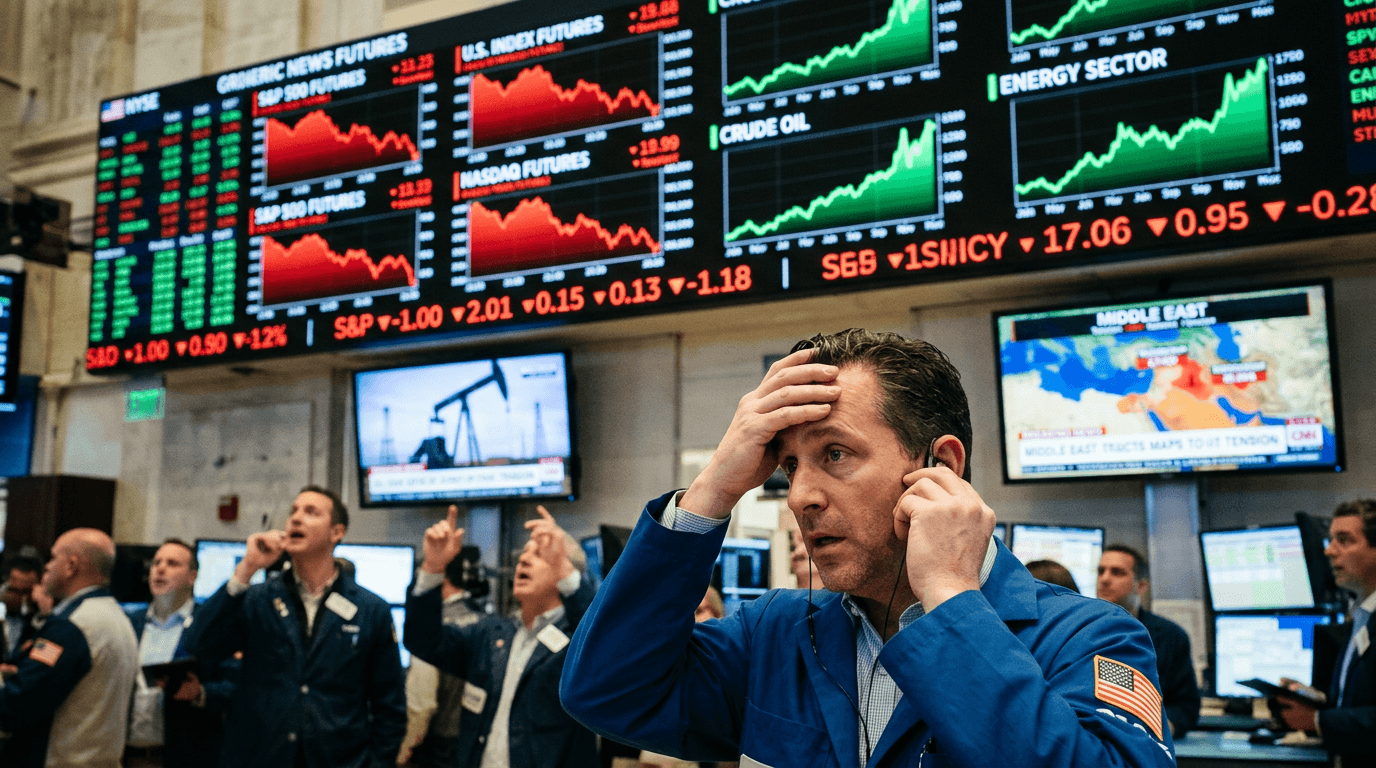
Oil prices and Middle East tensions are once again at the center of global market anxiety, sending a clear signal that geopolitical risk is more than just a headline for traders. When crude jumps 8–9% in a short window and key benchmarks break above psychologically important levels, equity markets and futures rarely remain untouched.[2][3][8] Understanding how this shock ripples through U.S. stocks and index futures is critical for anyone trading live or in a simulated environment.
Market Shock: Oil And Geopolitics Collide
The latest escalation between the U.S., its allies, and Iran has revived fears of a broader conflict in the Middle East, a region that still anchors a significant share of global oil supply.[3][4] Brent crude has pushed above the $80–85 per barrel area, while U.S. crude has seen single-day surges of more than 8%, reaching its highest levels in over a year.[2][8] These are not routine moves; they signal a sudden repricing of supply risk and shipping disruptions.
Equity markets have responded by turning risk-off. Major U.S. indices—including the Dow Jones Industrial Average, S&P 500, and Nasdaq—have dropped as investors reassess earnings, margins, and the macro backdrop.[2][3][8] In earlier phases of the conflict, Wall Street wiped out trillions of dollars in value within a month, with the Dow and Nasdaq entering correction territory after falling more than 10% from their peaks.[3] That kind of move illustrates how quickly geopolitical events can morph into broad market stress.
The reaction is global. In London, for example, higher oil prices have pressured stock indices even as energy names like BP and Shell climbed, highlighting the uneven impact across sectors.[4] For traders, the message is clear: oil shocks are not isolated; they are systemic events.
HOW OIL SURGES HIT U.S. STOCKS
There are three main transmission channels from an oil spike to U.S. equities: inflation, growth expectations, and risk sentiment.
First, higher oil prices feed directly into inflation through energy costs and indirectly through transportation and production expenses. When crude moves sharply higher, investors quickly price in the risk that central banks may need to keep interest rates elevated for longer to control inflation.[3][8] Higher rates compress valuation multiples, particularly for growth and tech names, making index-level declines more likely.
Second, growth expectations weaken. Rising oil and shipping costs squeeze profit margins for energy-intensive industries such as airlines, logistics, manufacturing, and tourism.[3][4] Those sectors often lead equity declines in oil shock episodes, as their earnings outlooks deteriorate fastest. At the same time, consumer spending can slow as fuel and utility bills absorb a larger share of household budgets, reducing revenue visibility for retailers and discretionary sectors.
Third, risk sentiment shifts. A potential war in the Middle East, escalating strikes, and retaliations increase uncertainty around trade routes, sanctions, and policy responses.[3][5][6] In such environments, investors rebalance portfolios away from cyclicals and into perceived safe havens, including certain commodities, defensive equities, and currencies like the U.S. dollar or yen.[3][5]
The result is a familiar but powerful pattern: broad indices like the Dow and S&P 500 turn lower; energy and select commodity-linked names outperform; and volatility spikes as traders grapple with both macro and geopolitical unknowns.[2][3][4]
Why Index Futures Could Amplify The Move
Oil shocks do not stop at the cash equity market. Index futures—such as S&P 500 and Nasdaq contracts—often register the impact earlier and more sharply, especially around key news or overnight developments.
Futures respond to expectations rather than realized data. When a Middle East headline breaks or crude gaps higher in electronic trading, index futures immediately incorporate the implied changes in inflation, growth, and earnings risk. Overnight moves in Brent and WTI can translate into notable adjustments in futures prices before the cash market opens.[2][6][8]
There are several reasons the spillover can be pronounced:
1) Leverage: Futures are inherently leveraged instruments. Small changes in expectations can generate outsized percentage moves once margin and positioning dynamics are considered.
2) Hedging flows: Institutional investors and market makers hedge portfolio risk using index futures. A sudden oil spike can trigger systematic hedging, leading to selling pressure in futures that then sets the tone for the cash open.
3) Algorithmic trading: Many systematic strategies respond to volatility, correlations, and macro triggers. Geopolitical headlines and commodity surges can activate risk-reduction rules, further magnifying futures swings.
For active traders—whether on a live platform or a simulated finance environment—this means index futures may become the primary vehicle for expressing views on the oil-geopolitics narrative. Short-term, the bias often tilts toward higher volatility, wider intraday ranges, and more abrupt reversals.
Trading Implications: Sectors, Safe Havens, And Simulated Strategies
An oil-driven risk episode rarely hits all assets equally. Sector and cross-asset divergences open both risks and opportunities.
Historically, energy producers and some commodity-linked firms benefit from higher prices, with large integrated oil companies posting double-digit gains even as the broader market sells off.[3][4] At the same time, airlines, shippers, and travel-related stocks tend to underperform as fuel and logistical costs rise.[3] Recognizing these patterns can help traders construct more targeted sector strategies instead of treating equities as a single block.
Safe-haven flows also matter. In past Middle East flare-ups, investors have rotated into certain currencies and defensive assets, while reducing exposure to high-beta equities.[3][5][6] Understanding these correlations is useful when building multi-asset portfolios or relative value trades, such as long energy/short discretionary or long defensive currencies/short cyclical FX.
For those using simulated finance (SimFi) environments, this backdrop is especially educational. A complex shock—geopolitical plus commodity plus macro—offers a rich testing ground for:
- Scenario analysis: How does a 5–10% overnight move in oil impact different indices and sectors?
- Risk management drills: How do stop-losses, position sizing, and hedging via index futures behave in volatile conditions?
- Multi-asset strategies: Can a combination of commodity, equity, and currency exposures produce more resilient portfolios during geopolitical stress?
By experimenting with these ideas in simulation, traders can refine playbooks without bearing real-world P&L risk, then apply those lessons more confidently in live markets.
Practical Takeaways For Traders
Oil surges tied to Middle East tensions are likely to remain a recurring feature of global markets, and each episode offers practical lessons:
- Monitor cross-asset signals: Track crude benchmarks alongside major indices and futures to identify when a commodity move is turning into a broader macro event.[2][3][8]
- Respect inflation and rate expectations: Rapid energy price increases can shift interest-rate narratives quickly, influencing valuation-sensitive sectors.
- Focus on sector dispersion: Energy producers and commodity beneficiaries may outperform, while fuel-intensive and discretionary sectors often lag.[3][4]
- Prepare for futures volatility: Index futures can move aggressively on geopolitical headlines, particularly outside regular cash hours, and can set the tone for the next trading session.[2][6][8]
- Use simulation to build resilience: Practicing response strategies to geopolitical and commodity shocks in a SimFi environment can improve real-world decision-making under pressure.
When oil and geopolitics collide, the impact on U.S. stocks is rarely linear or short-lived. For informed traders, these episodes are not just periods of heightened risk, but also opportunities to apply disciplined macro thinking, robust risk management, and thoughtful cross-asset strategy design.